Views: 0 Author: Site Editor Publish Time: 2026-04-14 Origin: Site


In industrial environments, cooling is not simply a supporting function. It is a core part of stable production, product quality, equipment protection, and long-term energy management. Whether a facility is involved in plastics processing, pharmaceuticals, food production, chemical operations, electronics manufacturing, or precision machining, the cooling system must perform consistently under demanding operating conditions. This is exactly why the water cooled scroll chiller has become such a practical solution for many industrial users. Compared with some other cooling arrangements, it offers a balance of efficiency, compact design, dependable operation, and strong temperature control. For companies that need continuous process cooling rather than occasional comfort cooling, these advantages matter every day. The real value of a water cooled scroll chiller is not limited to one feature alone; it comes from how multiple benefits work together to support industrial reliability, lower operating pressure on equipment, and help plants maintain more predictable performance over time.
Industrial processes often generate heat faster than natural ventilation or simple cooling methods can handle. If heat is not controlled properly, it can affect machinery, reduce product consistency, and shorten equipment life. In some industries, even a small temperature fluctuation can lead to process instability, product defects, or unplanned downtime.
A reliable cooling system is essential for:
· maintaining precise production temperatures
· protecting heat-sensitive machinery
· reducing the risk of overheating
· improving overall process stability
· supporting continuous plant operation
This is where a scroll chiller for industrial applications becomes important. When cooling performance needs to be steady, efficient, and suited to long operating cycles, a well-designed system can make a measurable difference.
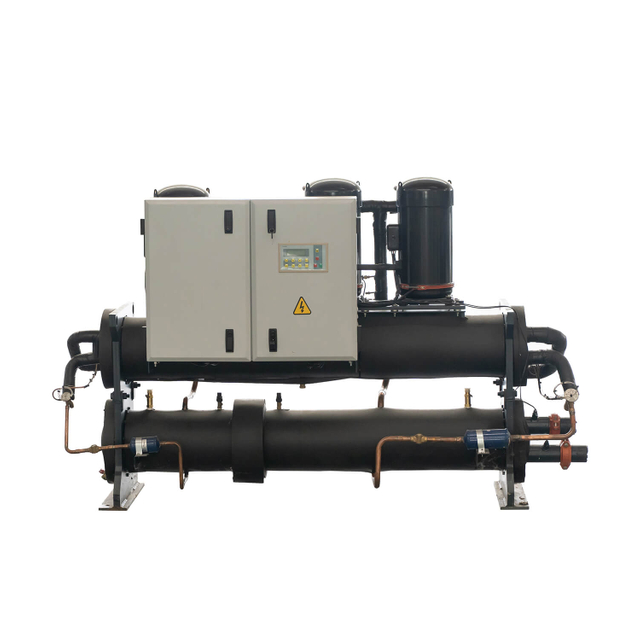
A water cooled scroll chiller is a cooling unit that uses scroll compressors and water as the condenser cooling medium. Instead of rejecting heat directly to outdoor air like an air-cooled system, it transfers heat through a water loop, often connected to a cooling tower or another heat rejection arrangement.
The basic working principle includes:
· the evaporator absorbs heat from the process water or chilled water loop
· the scroll compressor compresses refrigerant to raise its pressure and temperature
· the condenser transfers heat from the refrigerant to cooling water
· the expansion device lowers refrigerant pressure so the cycle can continue
Because the condenser side is water cooled, the system can usually maintain more stable condensing conditions, especially in large or controlled industrial settings. This contributes to one of the biggest reasons many facilities choose this design: better long-term operating efficiency.
One of the main benefits of a water cooled scroll chiller for industrial applications is energy performance. In many industrial settings, chillers operate for long hours every day. Even moderate efficiency gains can translate into meaningful cost savings over time.
Water-cooled systems often perform well because water is more effective than air at carrying heat away from the condenser. This allows the chiller to operate under more favorable heat rejection conditions, especially when compared with systems exposed to fluctuating outdoor temperatures.
When condensing temperatures stay more stable, the compressor may not need to work as hard. That can improve system efficiency and reduce energy consumption during sustained operation.
This benefit is often especially valuable in:
· factories with year-round production
· process lines with continuous thermal loads
· facilities where electricity cost control is a priority
· operations requiring multiple cooling zones
For plants managing large cooling loads, the efficiency advantage of an industrial water cooled chiller can become one of the strongest arguments for system selection.
Not every industrial application can tolerate broad temperature swings. In some manufacturing environments, cooling accuracy directly affects final product quality. A stable chilled water supply helps keep processing conditions under control.
Water cooled scroll chillers are often chosen for applications such as:
· injection molding
· laser and electronics cooling
· food and beverage process control
· laboratory and pharmaceutical support
· printing and coating lines
· machinery cooling in precision manufacturing
Because the heat rejection side is separated from ambient air influence more effectively than in air-cooled designs, water-cooled units can provide steadier operation in many cases. This allows users to maintain tighter control over the process loop temperature and reduce variation during production cycles.

Noise is not always the first factor considered during equipment selection, but in many industrial facilities it still matters. Mechanical rooms, equipment platforms, and enclosed utility spaces often benefit from lower-noise cooling solutions.
A water cooled scroll chiller generally avoids the large condenser fan noise associated with many air-cooled systems. Scroll compressors themselves are also known for relatively smooth and quiet operation when compared with some other compressor types.
Lower noise can help improve the working environment, especially in facilities where:
· chillers are installed close to production areas
· indoor mechanical space is limited
· operators and maintenance teams work near utility equipment
· local environmental noise standards must be considered
This does not mean every water-cooled unit is silent, but it often offers a quieter operating profile that suits certain industrial environments better.
Industrial plants often have limited installation space, particularly when equipment must fit into an existing utility room or retrofit project. One practical benefit of scroll chiller technology is that it can support relatively compact equipment layouts while still delivering dependable performance.
This is especially useful when companies need to:
· modernize an older cooling system
· expand production without rebuilding the plant utility area
· install cooling equipment in restricted mechanical rooms
· serve multiple process loads from a centralized unit
Water cooled scroll chillers can be designed to offer strong cooling capacity in a footprint that works well for modern industrial layouts. This balance between size and performance is one reason they remain popular across a range of medium-duty and heavy-duty process cooling applications.
The scroll compressor is a major reason these chillers are favored in industrial applications. Its compression mechanism is relatively simple, with fewer moving parts than some other traditional compressor types. This can support smooth operation and dependable performance when the system is correctly designed and maintained.
The table below shows how a water cooled scroll chiller can support industrial applications when compared with typical cooling priorities in a plant environment.
Industrial Need | How a Water Cooled Scroll Chiller Helps | Operational Benefit |
Stable process temperature | Maintains controlled chilled water output | Better product consistency |
Long running hours | Operates with strong energy efficiency | Lower operating cost over time |
Limited installation space | Compact equipment design | Easier plant integration |
Quiet mechanical environment | Lower fan-related noise | Improved workplace conditions |
Variable cooling demand | Scroll compressor handles changing loads well | More flexible operation |
Equipment protection | Removes excess process heat effectively | Longer equipment life |
Continuous production | Supports reliable cooling performance | Reduced risk of downtime |
This comparison makes it easier to understand that the value of a process cooling system is not just cooling capacity alone. It is also about how well the system aligns with real production needs.
Industrial buyers rarely choose a cooling system for one reason alone. They usually need a solution that fits technical, operational, and financial priorities at the same time. A water cooled scroll chiller is appealing because it addresses several of those concerns together. It can help improve energy efficiency, support stable process temperatures, reduce noise, fit into practical plant layouts, and offer reliable compressor-based performance for continuous operation. In many facilities, these combined strengths make it a more balanced choice than systems designed only around initial simplicity. The best results come when the chiller is selected as part of the wider production strategy, not just as an isolated utility device. That means understanding actual process load, operating hours, and long-term maintenance expectations.
From our perspective, the most important question is not simply whether a water cooled scroll chiller can cool effectively, but whether it can support industrial production in a dependable and efficient way over time. In real factory environments, that long-term reliability is what creates value. At Ruidong Group Co., Ltd, we believe cooling solutions should be evaluated based on actual application demands, system efficiency, and practical operating needs rather than marketing claims alone. For businesses that want to better understand the right cooling configuration for manufacturing, processing, or plant utility systems, learning more from an experienced supplier can be a useful next step. If you are exploring a water cooled scroll chiller for industrial applications, you can contact Ruidong Group Co., Ltd for more information.
Its main advantage is the combination of efficient heat rejection, stable temperature control, and reliable operation for continuous process cooling.
In many industrial settings, it can be better for efficiency and stable performance, especially where long operating hours and controlled condenser conditions are important.
They are widely used in plastics, food processing, pharmaceuticals, electronics, chemicals, machining, and other industries that require dependable process cooling.
It can help reduce operating costs over time by improving energy efficiency, protecting production equipment, and supporting more stable system performance.