Product Detail
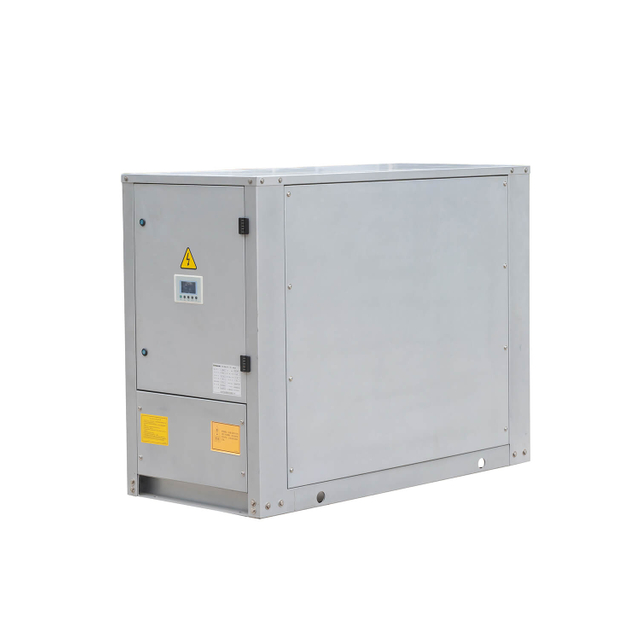
| Model | Z30FR | Z40FR | Z55FR | Z75FR | Z85FR |
| Cooling | Cooling capacity | kW | 26 | 34 | 47 | 62 | 70 |
| Input Power | kW | 10.1 | 13.1 | 17 | 20.8 | 23.4 |
| Running current | A | 19.1 | 24.8 | 32.2 | 39.5 | 44.5 |
| Heating | Heating capacity | kW | 24 | 29 | 40 | 55 | 62 |
| Input Power | kW | 9.9 | 12.9 | 16.8 | 20.4 | 23.2 |
| Running current | A | 18.6 | 24.2 | 31.5 | 38.3 | 43.7 |
| Start mode | Directly start |
| Adjustment ability | 0-50-100% |
| Refrigerant | R407c/R22 |
| Refrigerant charge | kg | 8 | 10 | 14 | 18 | 22 |
| Refrigerant control device | TXV |
| Compressor | Type | Hermetic scroll compressor |
| Qty | 2 | 2 | 2 | 2 | 2 |
| Power supply | 380V/3N/50HZ |
| Groundwater flow | m3/h | 10 | 20 | 20.00 | 20 | 20 |
| Fan | Air Flow | m3/h | 6000 | 8000 | 12000 | 15000 | 15000 |
| Power | kW | 1.5 | 2.2 | 3 | 4 | 4 |
| ESP | Pa | 200 | 250 | 300 | 350 | 350 |
| Application area |
| m2 | 150 | 220 | 300 | 450 | 550 |
| Dimension | L | mm | 2086 | 2086 | 2440 | 2640 | 2640 |
| W | mm | 1170 | 1170 | 1370 | 1370 | 1370 |
| H | mm | 2150 | 2150 | 2150 | 2384 | 2384 |
| Air outlet | A | mm | 500 | 500 | 630 | 630 | 630 |
| B | mm | 500 | 500 | 630 | 630 | 630 |
| Return air | C | mm | 735 | 735 | 910 | 1030 | 1030 |
| D | mm | 1110 | 1110 | 1110 | 1310 | 1310 |
| Fresh air | E | mm | 358 | 358 | 460 | 460 | 460 |
| F | mm | 1110 | 1110 | 1110 | 1110 | 1110 |
| weight | kg | 540 | 540 | 790 | 830 | 980 |
| Note : | Cooling: Ambient temperature DB 35 ℃,indoor temperature 21℃ |
| Heating: Ambient temperature DB 7 ℃,WB 6 ℃ |
FAQ
1. How do Ruidong air conditioning units for mushroom cultivation differ from traditional commercial air conditioners?
Ruidong air conditioning units for mushroom cultivation are custom-designed for the controlled environments of industrial mushroom cultivation facilities, and differ fundamentally from traditional commercial air conditioners: First, traditional commercial air conditioners are typically designed to operate efficiently within a range of 16°C to 32°C, whereas mushroom cultivation requires a wide temperature range of 22°C–27°C during the mycelium growth phase and 12°C–20°C during the fruiting phase. This unit supports precise switching between cooling and heating modes; Second, the unit features a built-in two-stage air filtration system (pre-filter + medium-efficiency filter) that effectively removes contaminants such as spores, mold, and bacteria from the air—a critical function not found in traditional air conditioners. Additionally, the unit employs a high-airflow centrifugal fan and a high-static-pressure design (200–350 Pa), enabling it to overcome the resistance of long-distance ductwork within mushroom cultivation rooms and achieve uniform air distribution.
2. Which edible mushroom varieties is this air conditioner suitable for?
This unit is suitable for the industrial cultivation of various edible mushrooms, including king oyster mushrooms, enoki mushrooms, maitake mushrooms, enoki mushrooms, button mushrooms, cordyceps, and black fungus. Based on the temperature requirements of different mushroom species, the unit can flexibly adjust its operating mode: for low-temperature species such as enoki mushrooms and oyster mushrooms, the unit can stably maintain a low-temperature fruiting environment; for medium-temperature varieties, the unit provides comprehensive functions including cooling, heating, filtration, and air conditioning. The specific temperature requirements for different species are as follows: oyster mushrooms thrive at 16–20°C, button mushrooms at 14–17°C, and shiitake mushrooms at 12–16°C. Through precise temperature control (±0.5°C accuracy), this unit can meet the environmental requirements throughout the entire process from mycelium growth to fruiting.
3. What is the unit’s temperature and humidity control accuracy?
This unit features precise temperature and humidity control capabilities. According to industry technical standards for comparable products, the temperature control accuracy of this specialized mushroom cultivation air conditioning unit reaches ±0.5°C. Additionally, the unit automatically controls multiple environmental parameters—including temperature, humidity, CO₂ concentration, and lighting—to ensure the microenvironment within the mushroom cultivation room remains in optimal condition at all times. During the fruiting stage, relative humidity must be maintained between 85% and 95%. This unit can be integrated with humidification equipment to achieve precise humidity management, preventing cap cracking or dehydration.
4. How does the unit’s air filtration system prevent contamination?
Mushrooms are highly sensitive to airborne contaminants such as mold spores and bacteria, making air filtration critical for preventing contamination. The unit is equipped with a high-seal static pressure fan and a high-efficiency filtration outlet, incorporating both primary and medium-efficiency air filters. Specifically: A pre-filter is installed at the return air inlet to intercept large dust particles and impurities; a medium-efficiency filter is installed at the fresh air inlet to effectively prevent contamination from outside air. Additionally, the evaporator coil design of this unit effectively eliminates spores in the air that could cause contamination, maintaining a hygienic and clean growing environment. Industry guidelines recommend maintaining positive air pressure within the mushroom growing room to further prevent the entry of contaminants.
5. Does this unit support energy-saving operation?
Yes, this unit features multiple energy-saving designs. First, it utilizes a hermetic scroll compressor, which offers a higher energy efficiency ratio compared to traditional reciprocating compressors. Second, the unit can utilize natural cooling sources such as well water, river water, lake water, or reservoir water for cooling, significantly reducing operational energy consumption during transitional seasons or in cold regions. Additionally, the unit supports three-stage regulation (0-50-100%), automatically adjusting output based on actual heat load to avoid unnecessary energy waste. For long-term mushroom cultivation facilities, selecting air conditioning equipment with high energy efficiency ratios (EER/COP) can significantly reduce annual operating costs.
6. Is the unit easy to install and maintain?
The unit features a modular design, making installation and maintenance relatively straightforward. The unit is floor-standing and does not require a dedicated machine room. Its outdoor installation design, combined with an external power supply, eliminates fire risks. For maintenance, the filtration system supports periodic cleaning or replacement: the pre-filter (nylon mesh) can be repeatedly washed and reused; the medium-efficiency bag filter requires periodic replacement. The condensate drainage system is well-designed, with a condensate outlet located below the cooling coil for convenient drainage management.
7. What refrigerant does the unit use? Is it environmentally friendly?
This unit uses R407c or R22 refrigerant. As an alternative to R22, R407c has a lower ozone depletion potential (ODP) and is currently one of the more environmentally friendly options. The refrigerant charge varies by model: 8 kg for the Z30FR and 22 kg for the Z85FR. Please note that as environmental regulations become increasingly stringent, we recommend consulting Ruidong for the latest eco-friendly refrigerant options.
8. What is the warranty period for the unit?
In accordance with Ruidong’s standard warranty policy for similar products, this unit comes with a 5-year warranty. We recommend confirming the specific warranty coverage and terms with the sales team at the time of purchase.
9. Why does mushroom cultivation require a specialized air conditioning unit? Can’t a standard air conditioner be used instead?
Mushrooms are organisms that are extremely sensitive to their environment. Different growth stages (mycelium growth, primordia formation, and fruiting) have distinctly different requirements for temperature, humidity, CO₂ concentration, and lighting. Standard commercial air conditioners are primarily designed for cooling and heating and cannot meet the following critical needs:
Precise humidity control: The fruiting stage requires a high-humidity environment of 85%–95%. Standard air conditioners excessively dehumidify during the cooling process, causing the mushroom caps to crack;
CO₂ concentration management: Mushroom respiration produces large amounts of CO₂. During the fruiting stage, CO₂ levels must be maintained below 1,000 ppm, which requires a dedicated fresh air supply and exhaust system;
Air filtration: Mushrooms are extremely sensitive to airborne contaminants, requiring an effective filtration system to prevent contamination by mold spores;
Uniform airflow distribution: Standard air conditioners deliver concentrated airflow, which can create dry air currents that blow directly onto the mushrooms. In contrast, this unit, when paired with a duct system, achieves low-speed, uniform airflow at 0.1–0.3 m/s, preventing dehydration of the mushrooms.
Therefore, a professional mushroom cultivation air conditioning system is essential equipment for achieving high yields, high quality, and stable mushroom production.
10. What are the power requirements for the unit?
The unit operates on 380V/3-phase/50Hz. For export projects, Ruidong can provide versions with customized voltage and frequency; we recommend clearly specifying local power standards when requesting a quote.
11. What technical support does Ruidong provide after an order is placed?
Ruidong provides comprehensive technical support services, including: pre-sales selection advice (recommending the optimal model based on cultivation variety, area, and climatic conditions); installation guidance (providing installation drawings and remote technical support); commissioning services (ensuring the unit achieves optimal performance after startup); post-sales maintenance training (guiding users on daily operations, filter system cleaning, and troubleshooting); and spare parts supply (core components such as compressors, fans, and controllers are all in stock).